

Learn how reverse engineering services in Perth use 3D scanning, CAD modeling, and custom manufacturing to help recreate broken, worn, and hard-to-find parts. Learn how Vertex Manufacturing helps businesses and individuals create replacement parts without original technical drawings.
When a part breaks and the original replacement is no longer available, finding a new one can be difficult. Reverse engineering helps recreate parts without the original drawings or CAD files.
At Vertex Manufacturing, we use 3D scanning, CAD modelling and custom manufacturing to help Perth businesses and individuals recreate hard-to-find parts.
What Is Reverse Engineering?
Reverse engineering is the process of examining an existing physical component to understand its dimensions, shape and function. This information is then used to develop a digital model that can support manufacturing a replacement.
Unlike traditional product development, which starts with a new design, reverse engineering works backwards from an existing object.
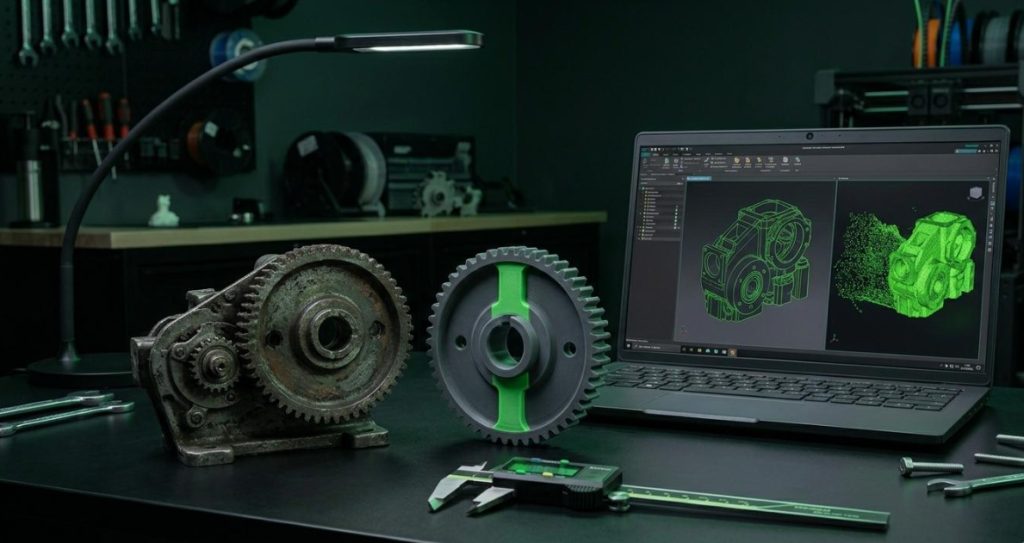
For example, imagine an older machine has a damaged plastic gear. The supplier has discontinued the part, and no engineering drawings are available. Instead of replacing the entire machine, the original gear can be measured, digitally recreated and assessed for manufacturing.
This approach is particularly valuable for businesses operating older equipment or specialised machinery.
Why Is Reverse Engineering Important for Perth Businesses?
Perth has a strong industrial sector, with businesses working across mining, manufacturing, automotive repairs, construction and engineering.
Many of these businesses depend on machinery that has been operating for years. When a small component fails, replacement parts may be difficult to source locally or from overseas suppliers.
Professional reverse engineering in Perth can help address these challenges.
Some key benefits include:
- Replacement of obsolete parts: Recreate components that manufacturers no longer produce.
- Reduced equipment downtime: Explore local replacement options instead of waiting for unavailable parts.
- Custom design improvements: Modify existing components to meet new requirements.
- Digital documentation: Preserve CAD files for future repairs and manufacturing.
- Flexible production: Manufacture individual components or small batches.
- Potential cost savings: Avoid unnecessary replacement of complete assemblies where a suitable individual part can be reproduced.
The biggest advantage is flexibility. Rather than relying entirely on original suppliers, businesses can explore alternative manufacturing solutions.
How to Recreate an Existing Part Using Reverse Engineering
Recreating an existing component involves more than simply copying its appearance. The replacement must also fit correctly and perform its intended function.
Here’s how the process typically works.
Step 1: Inspect the Original Component
The first step is to examine the existing part and understand how it operates.
Measurements, material properties, mounting points and signs of wear are assessed. Any damage or missing sections must also be identified.
If the component is broken, the remaining pieces may still provide enough information to reconstruct the original design.
Understanding the part’s application is essential because a replacement must work within the existing equipment.
Step 2: Capture the Part Using 3D Scanning
Once the component has been assessed, 3D scanning can capture its external geometry.
A professional scanner collects surface measurements that are processed into a digital representation of the object. This is particularly useful for complex curves, irregular surfaces and detailed mechanical features.
At Vertex Manufacturing, our 3D scanning services in Perth support part replication, design modification and digital archiving.
For simple components, manual measurements may be sufficient. More complex parts can require a combination of scanning and conventional measuring tools.
Step 3: Create an Accurate CAD Model
After collecting the measurements, the next step is to develop a computer-aided design (CAD) model.
CAD software allows the component’s dimensions, shapes and functional features to be reconstructed digitally.
Engineers can also correct worn surfaces, rebuild damaged sections or adjust the design where necessary.
An editable CAD model is especially valuable because it can be modified and reused for future manufacturing.
Vertex Manufacturing offers CAD design and engineering services to help convert physical components and scan data into manufacturing-ready digital designs.
Step 4: Select the Right Manufacturing Method
Once the CAD model is complete, the appropriate manufacturing method can be selected.
The choice depends on the component’s material, dimensions, strength requirements and intended application.
Common manufacturing options include:
- FDM 3D printing: Suitable for many plastic replacement components, brackets and functional prototypes.
- Resin 3D printing: Useful for intricate components requiring fine details and smooth surfaces.
- CNC machining: Suitable for precision metal and plastic components.
- Injection moulding: An option for repeat plastic component production.
Not every manufacturing process suits every part. Material performance, production quantity and dimensional requirements should guide the decision.
Step 5: Produce and Test the Replacement
After confirming the manufacturing method, a prototype or finished component can be produced.
The replacement should be checked for dimensional accuracy, fit and functional performance before being placed into service.
Some projects may require design adjustments after initial testing.
This is particularly important for components exposed to repeated movement, mechanical loads or elevated temperatures.
Can You Reverse Engineer a Broken or Damaged Part?
Yes. A component doesn’t always need to be completely intact for reverse engineering to be possible.
Cracked, worn or partially damaged parts can often provide useful dimensional information.
For example, Vertex Manufacturing successfully recreated a discontinued garage door drive gear using a damaged original component.
The broken gear was scanned, reconstructed in CAD and manufactured as a functional 3D-printed replacement, restoring the garage door mechanism.
This project demonstrates how reverse engineering can help when original drawings and replacement components are unavailable.
However, heavily damaged parts may require additional measurements, engineering analysis or reference components to establish their intended geometry.
What Types of Parts Can Be Reverse Engineered?
Reverse engineering can support many industries and manufacturing applications.
Common examples include:
- Mechanical gears and bushings
- Automotive fittings and brackets
- Plastic covers and equipment housings
- Industrial machine components
- Custom mounting fixtures
- Discontinued replacement parts
- Prototype products and assemblies
- Components without original CAD drawings
For Perth manufacturing and engineering businesses, this process can also support modifications to existing products.
The feasibility of reproducing a component depends on its complexity, material and operating requirements.
How Much Does Reverse Engineering Cost in Perth?
The cost of reverse engineering varies according to the component and the work required.
A small, uncomplicated plastic part may need only basic measurements and CAD modelling. A complex mechanical component could require detailed scanning, reconstruction and multiple manufacturing trials.
The main pricing factors include the object’s size, geometric complexity, required accuracy, original condition, CAD modelling time and manufacturing method.
Additional testing or specialist materials can also affect the final quotation.
For an accurate estimate, provide photographs, approximate dimensions and information about the part’s intended use.
Why Choose Vertex Manufacturing for Reverse Engineering in Perth?
Choosing a provider with both digital design and manufacturing capabilities can simplify a replacement-part project.
Vertex Manufacturing is an Australian-owned manufacturing business based in Wanneroo, Perth. We assist customers with 3D scanning, CAD design, reverse engineering and custom component manufacturing.
Our services support individuals, product developers, engineering workshops and businesses requiring practical solutions for difficult-to-source components.
Whether you have a damaged mechanical part or need to recreate an existing product without CAD files, we can assess your requirements and recommend an appropriate manufacturing approach.
Get Professional Reverse Engineering Services in Perth
A discontinued component doesn’t always mean an entire machine or assembly needs replacing.
With professional reverse engineering, an existing physical part can become the starting point for a new digital design and a suitable replacement.
At Vertex Manufacturing, we help customers across Perth and Western Australia explore practical solutions for obsolete, damaged and custom components.
Need to recreate an existing part? Visit vertexmanufacturing.com.au or contact Vertex Manufacturing to discuss your project and request a quote.
Frequently Asked Questions (FAQs)
1. Can reverse engineering recreate a part without original drawings?
Yes. An existing physical component can be measured or 3D scanned to develop a new CAD model, even when the original technical drawings are unavailable.
2. Can a broken component be reverse engineered?
In many cases, yes. Remaining physical features can help reconstruct damaged or missing sections, although additional measurements and engineering work may be necessary.
3. Is reverse engineering suitable for one-off replacement parts?
Yes. Reverse engineering can support the production of a single replacement component, particularly when combined with 3D printing or CNC machining.
4. How long does reverse engineering take in Perth?
Turnaround depends on complexity. At Vertex Manufacturing, digital scanning files typically take 1–3 business days, while CAD modelling generally takes 2–5 business days. Manufacturing and testing may require additional time.


